The trial of Adolf Eichmann established a precedent for holding individuals in court for acts declared criminal in the service of the Axis powers.
Posted by The Pete Quiñones Show, Checked
- Sources
- 3 support4 context
- Said
- 1 time·
- Confidence
- 60%
 The Pete Quiñones ShowOct 10, 2026
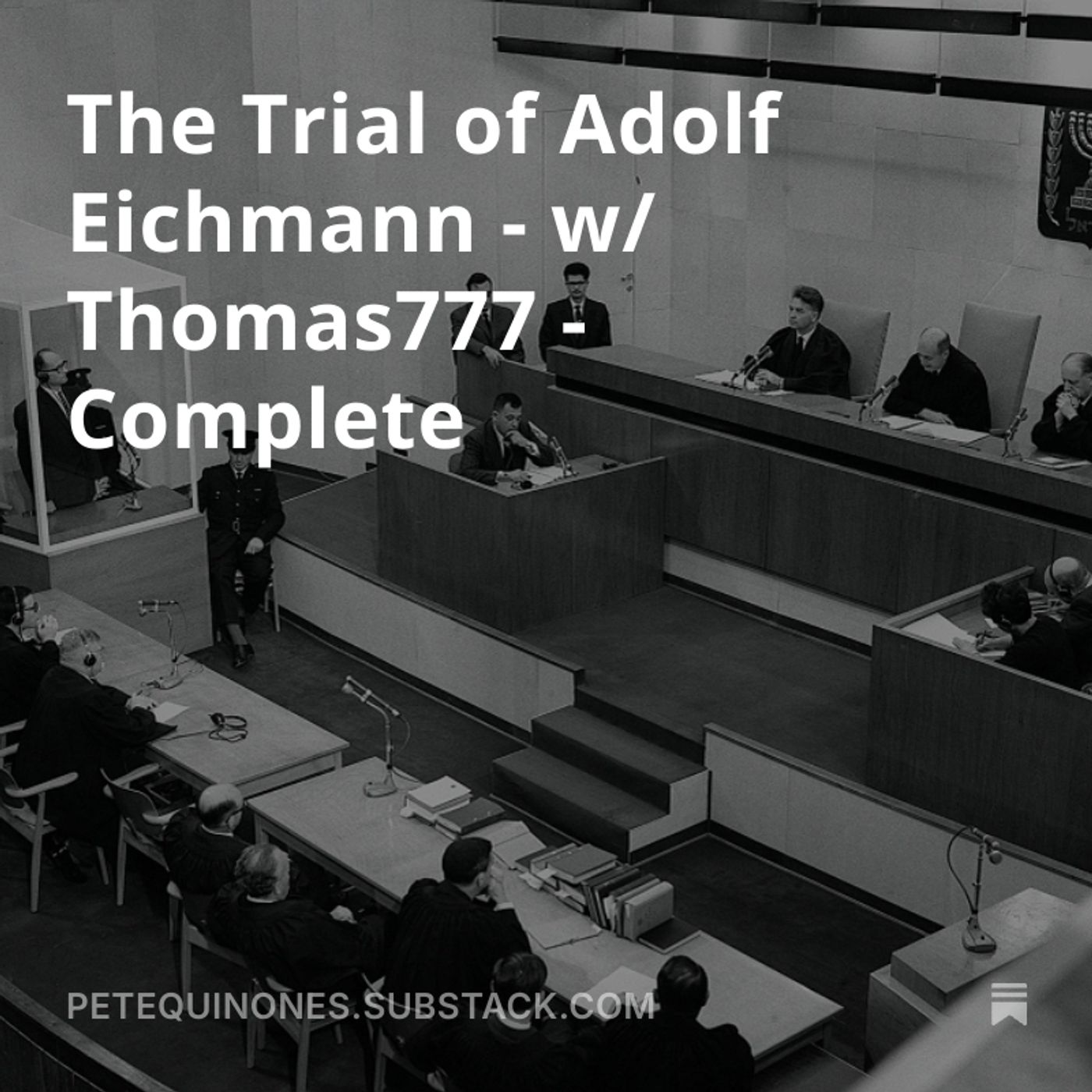
The sources describe the Eichmann trial as a landmark universal-jurisdiction case that revived prosecutions of Axis nationals for war crimes and crimes against humanity, which supports the claim that it set a precedent for trying individuals for Nazi-era crimes.
What was said
… That's very much coded into the world system, and that was put to the, a lot of things were put to the test with the trial of Adolf Eichmann. Including the sort of special dispensations Israel has at international law, and it also, it also had the force of solidifying and establishing as precedent for all time this. Anti-fascist convention, whereby people can be held into court. For Allegedly having been involved in what's declared to be, what was unilaterally declared to be criminal acts in the service of the Axis powers, and there was weird intrigues around Eichmann. And his apprehension. And he was something of an odd target. …
The Pete Quiñones Show · · from the transcriptPost →What we found
Supports. Amnesty International describes the 1962 Supreme Court confirmation of Eichmann's conviction as a landmark judgment and the first universal jurisdiction case in over a decade, after the US and UK had halted prosecutions of Axis nationals.[4]
Supports. The Asser Institute's case summary states Eichmann was tried in Jerusalem for war crimes, crimes against humanity and crimes against the Jewish people, and that he unsuccessfully contested the court's jurisdiction.[5]
Supports. A 2026 Cambridge analysis says the Eichmann trial derives its international legitimacy from the precedent set by the Nuremberg trials of Nazi leaders, and was a trial of figures whose prosecution was far from obvious.[6]
Context. Reuters and an AP piece both describe Israel using universal jurisdiction to prosecute Eichmann under the 1950 Nazis and Nazi Collaborators law, with Eichmann convicted on 15 counts and executed in 1962.[1][2][3]
Context. Hannah Arendt, as summarised in a Tel Aviv University paper, accepted Israel's jurisdiction over Eichmann while criticising the trial's framing around crimes against the Jewish people.[7]
Sources
7 sources: 2 fact-checkers, 1 primary, 4 not rated
- 1Some Israeli soldiers traveling abroad are targeted for alleged war ...apnews.com · fact-checker · cited for: context
- 2FACTBOX: Significant Nazi trialsreuters.com · fact-checker · cited for: context
- 3The Eichmann Trial: Some Legal Aspectsscholarship.law.duke.edu · primary source · cited for: context
- 4ior530132012engamnesty.org · not rated · cited for: supports
- 5www.internationalcrimesdatabase.org › case › 192ICD - Eichmann - Asser Instituteinternationalcrimesdatabase.org · not rated · cited for: supports
- 6Memory, Politics and Law -- The Eichmann Trial: Hannah Arendt ...cambridge.org · not rated · cited for: supports
- 7legala≠airstau.ac.il · not rated · cited for: context
Where this claim was made
Said in 1 published post
Related claims
- The Eichmann trial established special dispensations and exclusive privileges of a Jewish state within the international legal system.False
- The trial of Adolf Eichmann was intended to preserve or increase the reparations regime between Germany and Israel.Can’t tell
- David Ben-Gurion stated that Israel had jurisdiction over Adolf Eichmann because he was captured and brought to Israel, regardless of the legality of his capture.True
- Adolf Eichmann was sentenced to death.True
- The International Military Tribunal charged German officials with criminal conspiracy 15 years before the Eichmann trial.True